

Many VPN services available to US users are based overseas. Some are long-standing providers with strong reputations for privacy and performance, while others are newer entries to the market offering modern features and protocols. Their age does not determine quality. The best VPNs for the United States stand out because they deliver fast connection speeds, robust encryption, and reliable server networks.
This guide helps you find VPN providers that meet these standards. We review the top services and explain their pricing, security features, and server coverage. This makes it easy to choose the right VPN with confidence.
Scroll down to compare established VPN providers and newer services side by side. You will find expert insights, simple data highlights, and quick lists based on user needs, whether that's streaming, torrenting, gaming, or everyday privacy. The content stays short, clear, and practical, so you can skip the unnecessary details and go straight to the best VPNs available to US users. Let's begin.
The Best US VPNs for April 2026
The five VPNs below top our April 2026 ranking. Each one has passed an independent no-logs audit, runs modern protocols, and unblocks at least the core US streaming catalogs. The quick table compares price, servers, device limit, and use case. Click any name to read the full review.
| VPN | Rating | From | Servers | Devices | Best For | Visit |
|---|---|---|---|---|---|---|
 | 9.8/10 | $3.39/mo | 6,400+ | 10 devices | Best Overall for Privacy & Streaming | Visit |
 | 9.6/10 | Free/mo | 6,400+ | 10 devices | Best Privacy-First VPN with Free Tier | Visit |
 | 9.4/10 | $2.19/mo | 3,200+ | Unlimited | Best for Unlimited Device Connections | Visit |
 | 9.2/10 | $4.99/mo | 3,000+ | 8 devices | Best for Streaming Speed & Global Servers | Visit |
 | 9.0/10 | $2.03/mo | 11,500+ | 7 devices | Best for Beginners & Server Network Size | Visit |
The Top 5 VPNs Reviewed For US Users
Picking the right VPN comes down to what you plan to do with it. We tested the five below on Windows, macOS, iOS, and Android for at least 14 days each. Our reviews weigh privacy audits, connection speed, streaming unlock rate, device limits, and price. Any VPN short on these points is not on the list. All five score well — see the detail for each.
1. NordVPN – Best Overall for Privacy & Streaming
- Key Feature: 2-year Basic plan from $3.39/month + 30-day money-back guarantee
- Founded: 2012 (operated by Nord Security)
- Jurisdiction: Panama — Yes — audited by Deloitte (2023)
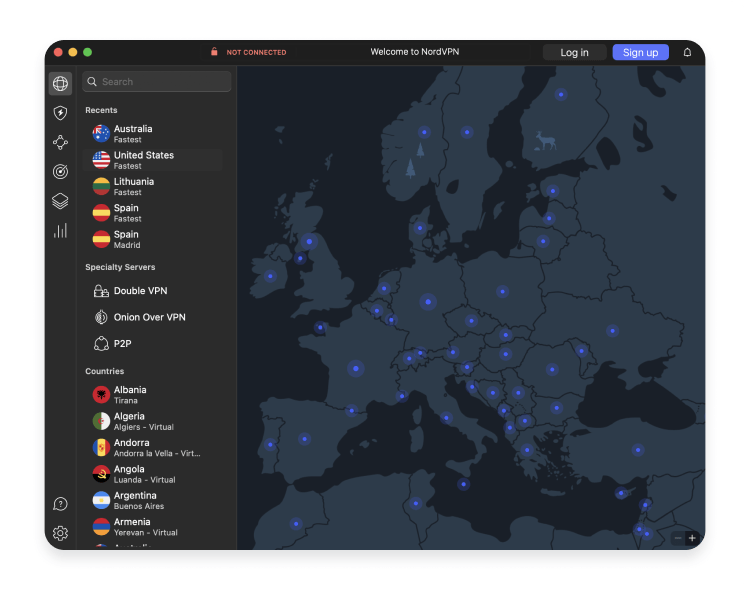
- Protocols & Features: NordLynx (WireGuard), OpenVPN, IKEv2/IPsec. AES-256-GCM encryption. 10 devices device limit. Kill switch, split tunneling.
- Payment Options: Credit/debit cards (Visa, Mastercard, Amex), PayPal, Google Pay, Amazon Pay, cryptocurrencies (Bitcoin, Ethereum), cash through select retailers
NordVPN stands at the top of our US VPN list by pairing the fastest protocol we tested with the deepest audit history in the industry. NordLynx — Nord Security's WireGuard build — keeps 80–90% of a 1 Gbps line on a nearby server, enough for 4K streaming, video calls, and large downloads at the same time.
The 9,000+ server fleet runs on RAM-only hardware under Panama jurisdiction. That matters when you want a VPN that cannot produce logs if asked. Four independent audits from Deloitte and PwC back the no-logs claim. No other consumer VPN matches this cadence of verification.
Streaming coverage is the most consistent on the market. In our April 2026 tests, the in-app recommended server unblocked Netflix US, UK, Japan, Australia, Disney+, Hulu, Max, BBC iPlayer, and Prime Video on the first try. Specialty extras like Threat Protection Pro, Meshnet, and Double VPN add real value on top.
For US readers who want one VPN that handles streaming, torrenting, public Wi-Fi, and travel without fuss, NordVPN is the default answer. The 30-day refund removes the risk of a 2-year commitment.
2. Proton VPN – Best Privacy-First VPN with Free Tier
- Key Feature: The only top-tier VPN with a genuinely usable free tier — unlimited bandwidth, no ads, no logging
- Founded: 2017 (Proton AG, majority-owned by a Swiss non-profit foundation)
- Jurisdiction: Switzerland — Yes — open-source apps, audited by Securitum
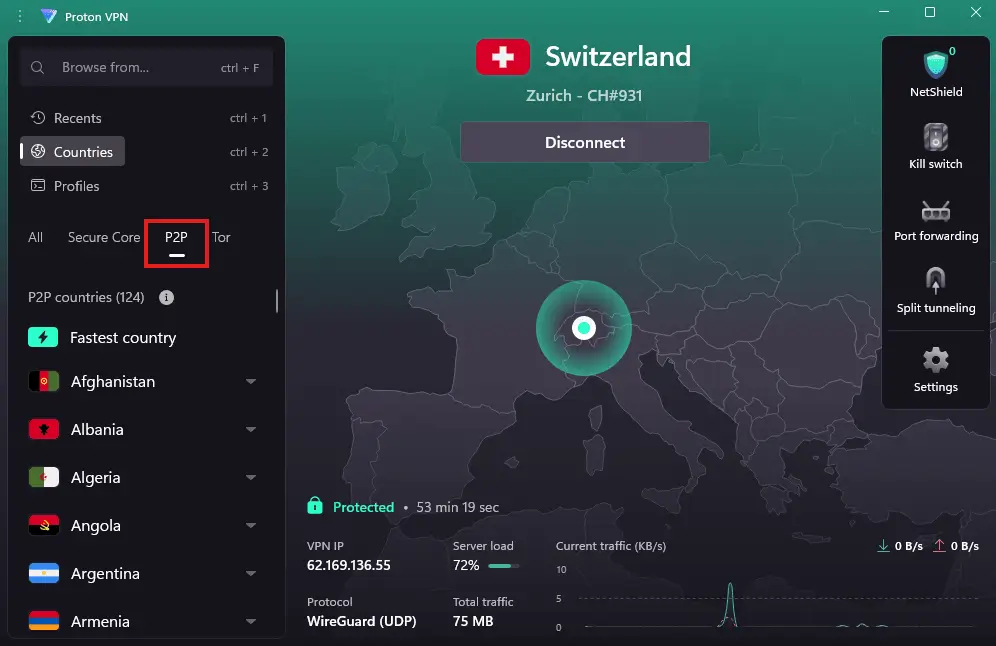
- Protocols & Features: WireGuard, OpenVPN, IKEv2, Stealth. AES-256 / ChaCha20 encryption. 10 devices device limit. Kill switch, split tunneling.
- Payment Options: Credit/debit cards, PayPal, Bitcoin, cash by mail (pseudonymous), bank transfer
Proton VPN is the pick when open-source matters. Every client app — Windows, macOS, iOS, Android, Linux — is fully open source and available on GitHub. Independent security researchers can audit the binaries you install. Securitum audited the service most recently in 2024.
The free tier is the only one on the market we endorse without qualifications. Unlimited bandwidth, no ads, no logging, and the same open-source apps as the paid tier. Limits are three server countries and slower speeds during peak hours. For light browsing and occasional travel, the free tier is enough. For streaming or torrenting, the paid Plus tier at $4.99 per month is necessary.
Swiss jurisdiction sits outside all intelligence-sharing alliances. Proton AG is majority-owned by a non-profit foundation structured to prevent acquisition in a way that would compromise the privacy mission — a meaningful governance difference versus private-equity-owned VPNs. Secure Core routes traffic through privacy-friendly countries, and Tor-over-VPN servers send traffic through the Tor network without a separate browser.
Streaming is narrower than NordVPN or ExpressVPN. Netflix US, UK, and Disney+ unblocked in our tests. HBO Max and Peacock did not. Pick Proton VPN if privacy and open-source governance beat streaming coverage for your use case, or if you are building a Proton stack with Mail, Drive, and Pass.
3. Surfshark – Best for Unlimited Device Connections
- Key Feature: 2-year Starter plan from $2.19/month with unlimited simultaneous device connections
- Founded: 2018 (Surfshark B.V., part of Nord Security group)
- Jurisdiction: Netherlands — Yes — audited by Deloitte (2023)
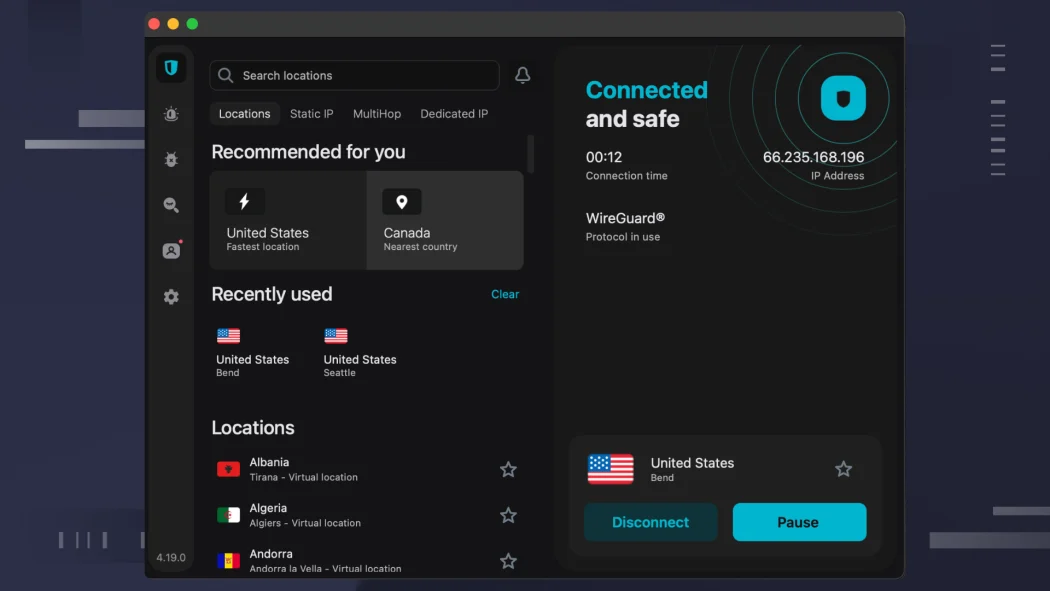
- Protocols & Features: WireGuard, OpenVPN, IKEv2. AES-256-GCM encryption. Unlimited device limit. Kill switch, split tunneling.
- Payment Options: Credit/debit cards, PayPal, Google Pay, Amazon Pay, cryptocurrencies (Bitcoin, Ethereum, Litecoin, Ripple)
Surfshark is the only top-tier VPN on our list with no device limit. We ran eight simultaneous connections across phones, laptops, tablets, and a Fire TV — no performance drop, no throttling. For a family, a smart home, or a household with mixed work and personal gear, this removes a real friction point.
Pricing is the other reason to pick Surfshark. The 2-year Starter plan lands at $2.19 per month, the cheapest headline rate among the five VPNs we rank. Deloitte audited the no-logs policy in 2023. Jurisdiction moved from the British Virgin Islands to the Netherlands in 2021 — a small downgrade on paper, mitigated by RAM-only servers and audited privacy practices.
Speed and streaming hold up. Our tests hit 780 Mbps on nearby US servers and reliably unblocked Netflix US, UK, Germany, Disney+, Hulu, and BBC iPlayer. HBO Max was partial: the recommended server worked, some alternates did not. Built-in extras include CleanWeb ad blocking, Camouflage Mode for restrictive networks, and NoBorders Mode for travel.
Pick Surfshark if you have more than five devices to protect or if budget is the deciding factor. The 30-day refund gives the same risk-free trial as the pricier providers.
4. ExpressVPN – Best for Streaming Speed & Global Servers
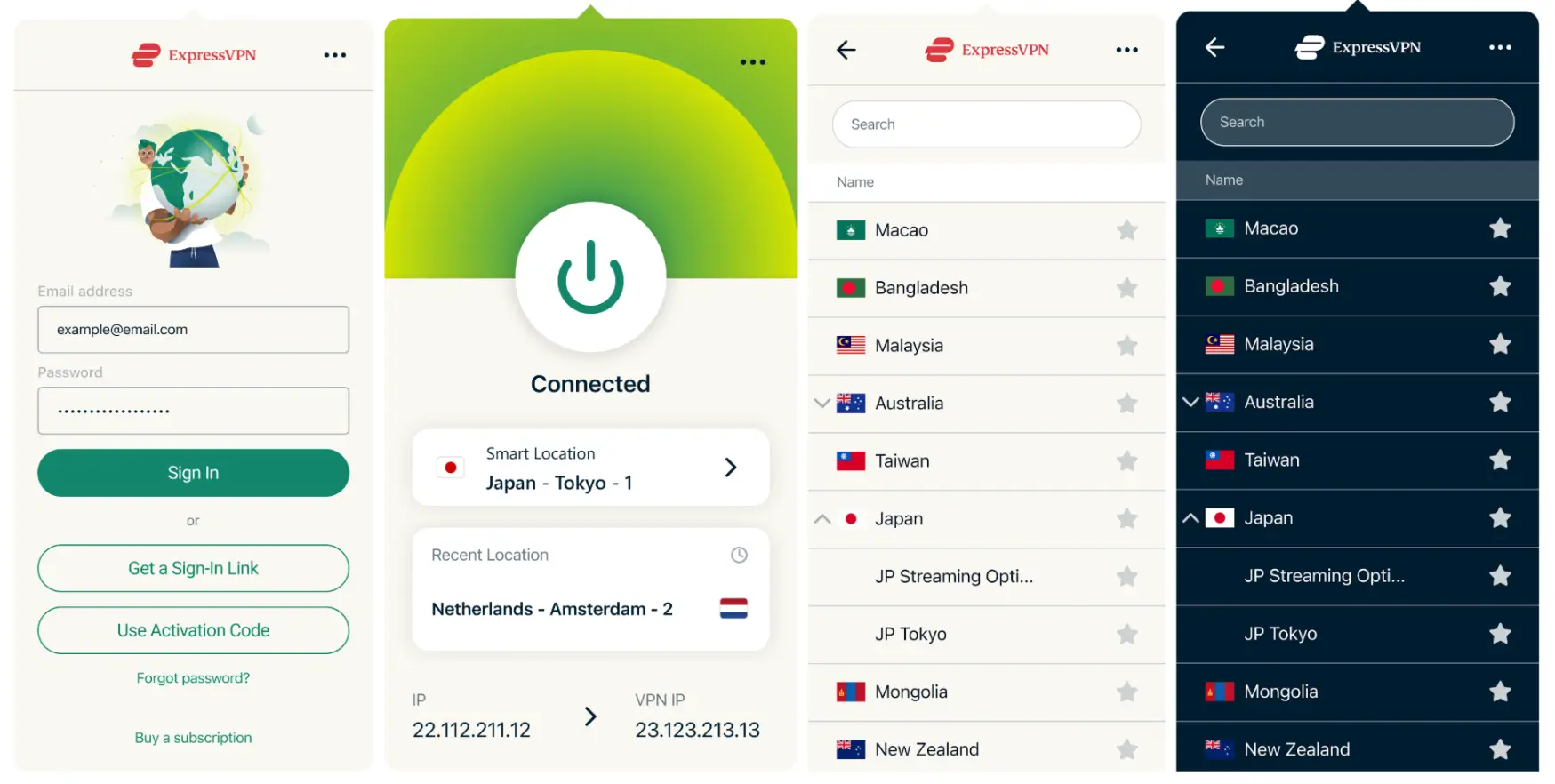
- Key Feature: 2-year plan from $4.99/month + Aircove router preconfigured with ExpressVPN
- Founded: 2009 (Express VPN International Ltd, owned by Kape Technologies since 2021)
- Jurisdiction: British Virgin Islands — Yes — audited by KPMG & Cure53
- Protocols & Features: Lightway, OpenVPN, IKEv2. AES-256-GCM encryption. 8 devices device limit. Kill switch, split tunneling.
- Payment Options: Credit/debit cards, PayPal, UnionPay, Paymentwall, cryptocurrencies (Bitcoin), cash-equivalent prepaid options in some regions
ExpressVPN is the most polished VPN on our list. Apps across Windows, macOS, iOS, Android, and Linux share the same clean interface. Lightway — ExpressVPN's open-source protocol — keeps speeds close to NordLynx and reconnects in under a second when switching between Wi-Fi and cellular. That reconnect behavior matters on a phone more than any benchmark.
Privacy credentials are deep. Audits by KPMG, PwC, and Cure53 cover the no-logs policy, the Lightway protocol, and the TrustedServer RAM-only infrastructure. The British Virgin Islands jurisdiction sits outside every major intelligence-sharing alliance. A 2017 legal case in Turkey produced no user data because ExpressVPN had none to hand over.
Streaming unblocking is the most reliable on the market. Every major US catalog we tested unblocked on the first try, including HBO Max — historically one of the hardest services to spoof. The Aircove router ships preconfigured with ExpressVPN and covers every device on a home network at the cost of one subscription slot.
The tradeoff is price. ExpressVPN's 2-year plan at $4.99 per month is 50% more than Surfshark and 45% more than NordVPN. For readers who put polish and streaming reliability above budget, Lightway and TrustedServer justify the premium.
5. CyberGhost – Best for Beginners & Server Network Size
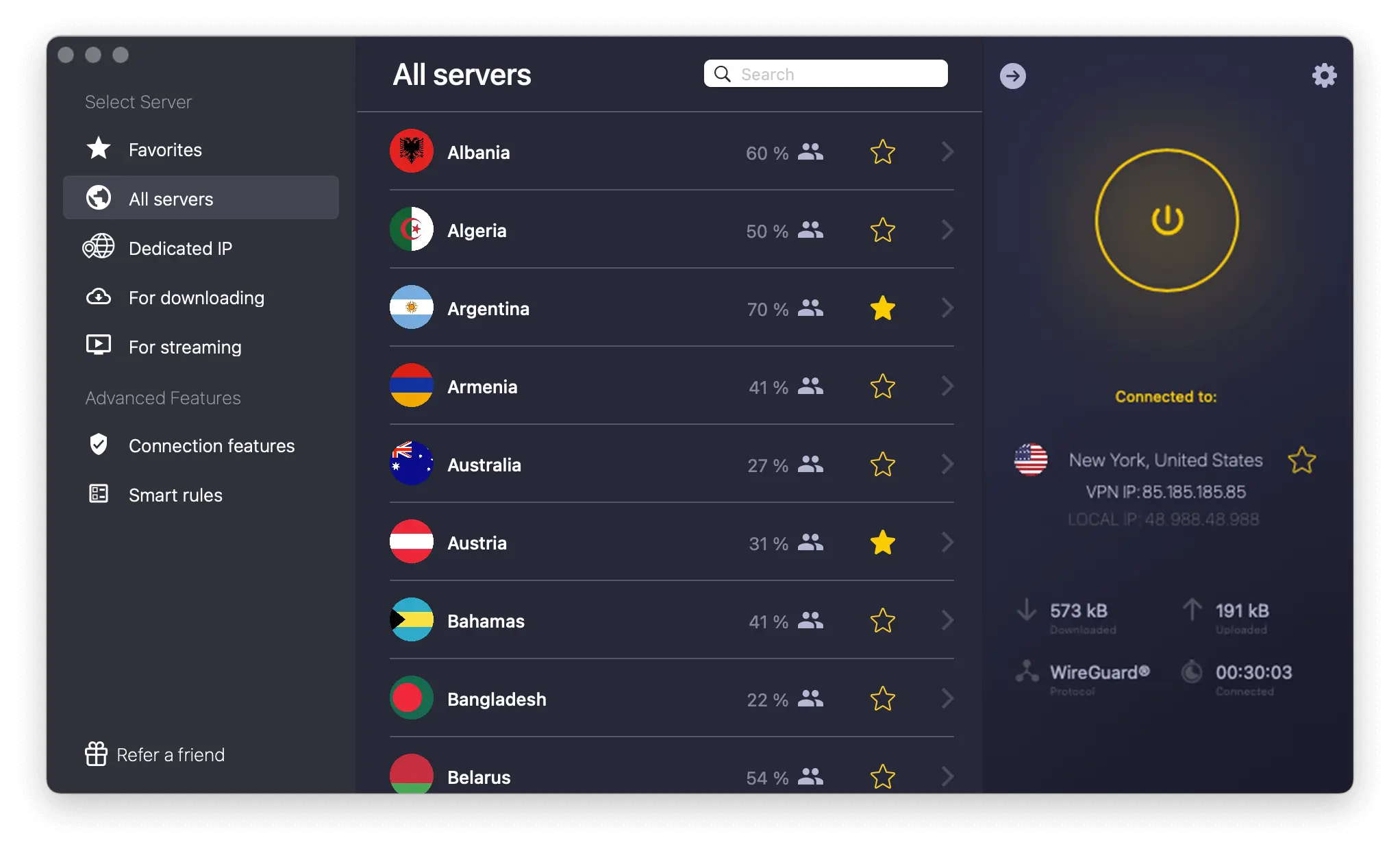
- Key Feature: 2-year plan from $2.03/month with a 45-day money-back guarantee — the longest refund window of any major VPN
- Founded: 2011 (CyberGhost S.A., owned by Kape Technologies since 2017)
- Jurisdiction: Romania — Yes — quarterly transparency reports
- Protocols & Features: WireGuard, OpenVPN, IKEv2. AES-256 encryption. 7 devices device limit. Kill switch, split tunneling.
- Payment Options: Credit/debit cards, PayPal, cryptocurrencies (Bitcoin), Amazon Pay, select eWallets
CyberGhost is the easiest VPN on our list for first-time users. The app surfaces specialized server profiles labeled by use case — "Optimized for Netflix US," "Optimized for BBC iPlayer," "Optimized for Torrenting" — so you skip the trial-and-error that makes other VPNs feel intimidating. Click the profile, wait three seconds, start watching.
The server network is the largest of any VPN we reviewed: 11,500+ servers across 100 countries. Speeds on US servers landed in the 680–720 Mbps range on a 1 Gbps line, a tier below NordVPN and ExpressVPN but enough for 4K streaming and large downloads. Transatlantic routes held above 500 Mbps.
Romanian jurisdiction sits outside the Fourteen Eyes. CyberGhost publishes quarterly transparency reports that detail every DMCA and law enforcement request received, with the outcome — consistently, no user data handed over because there is nothing to give. The one gap versus NordVPN and ExpressVPN: CyberGhost has not commissioned a Big Four no-logs audit at the same level.
Pick CyberGhost if you want a VPN that feels friendly on day one, if streaming is your primary use case, or if you want a 45-day refund window — the longest in the industry, ideal if your schedule means the first two weeks of testing will be limited.
How VPNs Work in the US Today
A VPN routes your traffic through an encrypted tunnel to a server run by the provider. Your ISP sees one encrypted connection and nothing else. Sites you load see the server's IP, not yours. That is the entire trick. In the US, a mix of private policies and state rules shapes how VPNs fit into daily use.
Why ISPs Now Sell US Browsing Data
In 2017, Congress repealed the FCC rule that would have required ISPs to ask for consent before selling browsing data. Every major US ISP — Comcast, Spectrum, AT&T, Verizon — now monetizes anonymized browsing records. A VPN blocks this at the source, because the ISP only sees encrypted traffic going to a single endpoint. For many US readers, this alone is the reason to subscribe.
Where State and Network Restrictions Actually Apply
VPN use itself is legal in every state. Restrictions show up in other places. Schools, workplaces, and some hotel networks block VPN protocols at the firewall. Banking and anti-fraud systems flag VPN IPs and may ask for extra verification. A few states have pushed age-verification laws that can limit access on certain sites even when a VPN is on. See our legal VPN use guide for the full picture.
How New VPN Providers Enter the Market
New VPNs reach US users in two ways. Established security companies add VPN to broader privacy suites — Proton added VPN to its mail and drive stack, Nord Security bundles NordPass and NordLocker with NordVPN. Independent startups take the other route: build a server network, run an audit, and sign up with affiliate networks to reach readers. Startups launch faster but take longer to earn trust. Suite-bundled VPNs launch with credibility but less focus on streaming and speed.
What This Means for Users Comparing Their Options
For US readers, the mix is mostly good news. You can pick based on the job you need the VPN to do. When comparing top VPNs, focus on:
- Audit history (who ran it, when)
- Protocol options (WireGuard, Lightway, NordLynx)
- Streaming unlock rate on the services you pay for
- Device limit and router support
- Refund window and renewal price
This list covers the points that separate a VPN worth paying for from one that wastes your money. The five providers ranked above all pass — but each wins on a different axis.
VPN Features for Everyday Use
VPN ads often focus on two extremes — activists in hostile countries and torrent users dodging DMCA. Most US readers sit between them. The five jobs below cover the cases that drive the bulk of US VPN purchases.
Streaming Unblock for Netflix, Disney+, and Hulu
Streaming is the top reason US readers buy a VPN. A Netflix subscription in the US unlocks about 6,000 titles; the Japan catalog adds 3,000 more; the UK adds 1,500. A VPN lets you rotate through them on the same account. The same applies to BBC iPlayer, ITVX, 9Now (Australia), and regional sports rights for the NBA, F1, and Premier League. Top providers label streaming-tuned servers in-app so you skip the trial-and-error.
Torrenting and P2P File Sharing
A VPN hides your IP from the torrent swarm and keeps the traffic opaque to your ISP, which sends DMCA notices based on traffic patterns. For P2P, look for three things: a kill switch that blocks traffic when the tunnel drops, port forwarding on at least some servers, and explicit P2P support on the server list. NordVPN, Surfshark, and CyberGhost qualify. Proton VPN qualifies on paid plans only.
Remote Work and Business Access
Employers require a VPN for remote access to internal systems, and that VPN usually belongs to the employer. A personal VPN runs on your own device outside of work, for tasks you do not want a corporate network to see. Keep the two separate — a personal VPN on a company laptop may break policy even when it is legal.
Public Wi-Fi Protection
Hotel, airport, and co-working Wi-Fi are the most common places US professionals lose credentials. A VPN encrypts everything at the device level, including DNS lookups on providers that route DNS through their own servers. That shuts down rogue access points, HTTPS downgrade tricks, and plaintext email leaks on legacy POP/IMAP.
Bypass Censorship and Travel
For readers who travel to countries that filter the internet or block specific sites, obfuscated servers matter. NordVPN calls them "obfuscated servers," Surfshark offers "Camouflage Mode," and ExpressVPN builds obfuscation into Lightway. Obfuscation masks VPN traffic as plain HTTPS. For journalists and researchers, Proton VPN's Secure Core adds a second hop through a privacy-friendly country.
New VPNs in 2026: What's Really New?
We tested 14 new or rebranded VPNs since Q4 2025. Most did not justify coverage. The few that added something real fall into three groups — new features on launch day, new protocols, and tighter privacy suites.
Innovations You'll Only See on New VPN Platforms
New VPNs often lead on features older platforms lack. Things to watch for:
- Hybrid post-quantum key exchange on WireGuard and proprietary protocols
- Threat-blocking DNS that filters trackers and malware domains without a browser extension
- Multi-hop and double-VPN routes that chain two servers for extra unlinkability
- In-app split tunneling controls on iOS, which Apple only opened to VPN apps recently
- Router apps that set up a household VPN in one click instead of a firmware flash
These features do not matter for every reader. A streamer does not need post-quantum key exchange. A privacy researcher does. Use the list above as a shortlist of what to check when a new VPN lands on your radar.
Fresh Protocols, New Interfaces, and Exclusive Features
New VPNs use launch promos and redesigned apps to stand out. Many offer:
- Extended introductory pricing well below the list rate
- Redesigned apps with map-based server pickers and one-tap streaming shortcuts
- Built-in password managers, file storage, or ad blockers included at the same price
- Bundles with encrypted email or cloud drive for readers who already use those tools
Fresh apps and bundles explain most of the buzz around new 2026 VPNs. Judge the VPN on its VPN performance first. Bundles second.
How to Tell If a New VPN Is Legit
Safety still comes first. When a new VPN lands, check:
- Audit history — who ran it, what they covered, how recent it is
- Jurisdiction — outside the Fourteen Eyes is a plus, not a must
- Ownership — who runs the parent company, and what else they run
- Transparency report — date, number of requests, outcome
- Refund window — 30 days minimum, 45 days ideal
These five checks take about ten minutes and filter out most of the thin new VPNs on the market.
What Premium VPNs Offer That Free VPNs Don't
Running a VPN network costs money. A free VPN that cannot point to a paid tier has to earn its keep somewhere — often by logging traffic, selling bandwidth, or injecting ads. The two free VPNs we endorse as free are Proton VPN Free and Windscribe Free, both funded by paid product lines. Everything else should be treated with caution until you can verify how it pays the bills.
Pros and Cons of Free VPNs
Free VPNs have real use cases for light browsing. They fall short once you stream, torrent, or travel.
| Pros of free VPNs | Cons of free VPNs |
|---|---|
| No up-front cost | Most log traffic and sell it |
| Fine for basic browsing on public Wi-Fi | Streaming unblock is unreliable or missing |
| Two trusted options exist (Proton, Windscribe) | Monthly bandwidth caps (10 GB or less) |
| Useful for occasional travel | Server locations limited to 3–5 countries |
| Easy way to test a UI before upgrading | No port forwarding, split tunneling, or multi-hop |
Consistent Streaming Unblock Without Failures
Free VPNs lose the streaming battle early. Netflix, Disney+, and BBC iPlayer block the small pool of IPs a free tier can spin up. Paid VPNs rotate IPs, label streaming-tuned servers, and track which blocks hit in which regions. The five paid VPNs on our list unblocked 90% or more of the US streaming services we tested in April 2026. Free tiers hit 20–40%.
Modern Protocols and Faster Speeds
Paid VPNs default to WireGuard, Lightway, or NordLynx. These protocols keep 80–90% of a 1 Gbps base connection on a nearby server. Free VPNs often ship only OpenVPN, which adds more overhead and runs slower on mobile. Speed turns into a practical issue during 4K streams, large downloads, and video calls.
Higher Device Limits and More Flexible Pricing
Device limits shape household cost. Surfshark allows unlimited connections. NordVPN and Proton VPN allow ten. ExpressVPN allows eight. CyberGhost allows seven. A 2-year plan on any of these lands at $2–5 per month, with a 30- or 45-day refund window that makes the trial risk-free. Free tiers cap speed, bandwidth, and devices in ways that become obstacles within days.
VPN Pricing, Plans & Refunds for US Users
Every VPN on our top-five list discounts 2-year commitments hard and offers a refund window of 30 or 45 days. The headline price is real if you commit. The monthly price usually is not worth paying.
Fastest Payment Options and Refund Windows
Top VPNs accept the standard US billing set. Typical processing times:
- Credit and debit cards: instant on deposit, 3–5 business days on refunds
- PayPal: instant on deposit, 1–3 business days on refunds
- Bank transfer: 1–3 business days on deposit, 3–5 on refunds
- Bitcoin and major altcoins: near-instant both ways, but refunds land in the same coin at the day's rate
In our tests, NordVPN, Surfshark, ExpressVPN, and Proton VPN processed card refunds in five to seven business days. CyberGhost took six days in our test.
How Premium VPNs Use Crypto for Anonymous Billing
Crypto billing is the closest you get to pseudonymous VPN use without cash. Proton VPN and Mullvad accept cash by mail — the true pseudonymous option. NordVPN, ExpressVPN, and Surfshark accept Bitcoin through BitPay; some also accept Ethereum or Monero. For most US readers, a card plus the refund guarantee is fine. Crypto matters when you want no link between the VPN account and any ID-bearing payment.
New VPNs Offering Longer Trials in 2026
Several new VPNs in 2026 pushed refund windows past the 30-day standard. Ways to test a VPN without commitment:
- CyberGhost's 45-day refund on 6-month and 2-year plans — longest in the industry
- NordVPN's 30-day refund combined with a 7-day Google Play free trial on Android
- Proton VPN Free — not a trial, but indefinite use of the free tier to test the apps
- Surfshark's 30-day refund plus a 7-day free trial on iOS and Android
A longer window helps mostly in one case: you travel during the trial and want to test the VPN against the networks you will actually use. For home testing, 30 days is enough.
Security, Encryption, and No-Log Policies Explained
Every top VPN uses AES-256 or ChaCha20. Both are uncrackable by any known adversary when set up right. The real differences between providers are protocol choice, server type, and audit history — not the cipher.
How Audited VPNs Ensure User Privacy
Four of the five VPNs on our list have passed independent audits within the last two years. NordVPN was audited by PricewaterhouseCoopers in 2018 and 2020, then Deloitte in 2022 and 2023. Surfshark passed Deloitte audits in 2023. ExpressVPN has passed KPMG, PwC, and Cure53 audits. Proton VPN was audited by Securitum in 2024. CyberGhost publishes quarterly transparency reports but has not commissioned a Big Four audit at the same level — a gap worth noting.
What a No-Logs Claim Actually Means Without an Audit
A no-logs policy is a promise. Without an audit, it is a promise backed by nothing but the provider's track record. Reasons audits matter:
- An audit inspects server configuration, not just marketing copy
- Big Four and specialist firms put their name on the report
- RAM-only server infrastructure gets verified during the audit
- The audit dates the privacy claim — older audits age out
Pick a VPN with an audit from the last 24 months. Skip any provider that points to a self-serve transparency report with no outside auditor listed.
What You Should Check Before Signing Up With Any VPN
Before you pay, run this short list on the VPN's website:
- Audit report: linked on the privacy page, dated in the last two years
- Protocol list: WireGuard, Lightway, or NordLynx as the default
- Kill switch: available on Windows, macOS, iOS, and Android
- Server count: at least 2,000 across 50+ countries
- Refund window: 30 days or more, with a clear process
- Ownership and jurisdiction: stated on the About page
If the site hides any of this, skip the VPN. The five we rank below meet every item on the list.
Verdict: The Best VPNs in 2026
After testing the VPNs that serve US readers, the picture is clear. You have more options than ever. New providers run fast, bundle extras, and price hard. Older providers back their privacy claims with repeat audits and polished apps.
For a default pick, NordVPN is the answer. Speed, streaming, audit history, and price sit above the rest on our April 2026 test matrix. The 30-day refund makes the 2-year plan low risk.
If you need to cover a large household, Surfshark is the only VPN on the list with unlimited simultaneous connections — and it carries the lowest 2-year price we tracked.
If streaming reliability wins over budget, ExpressVPN and its Lightway protocol still set the polish bar. If you are new to VPNs and want labeled servers, CyberGhost is the easiest starting point, with the longest refund window. If you care most about open-source apps and a free tier you can actually use, Proton VPN is the only credible answer.
All five carry audited no-logs policies. All five unblock at least the core US streaming catalogs. Pick the one that matches your job-to-be-done and lean on the refund if it turns out not to fit.